
Where exactly is Chianti?
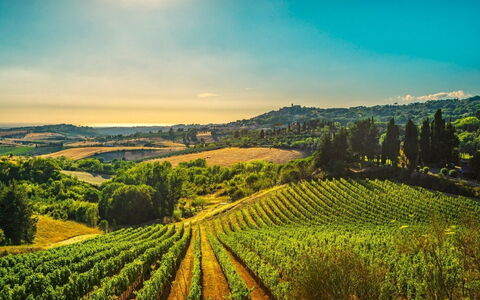
Chianti is often used loosely to describe a large part of the Tuscan countryside south of Florence. The historic Chianti Classico territory is more precise.
It stretches between Florence and Siena and covers the whole municipalities of Greve in Chianti, Castellina in Chianti, Radda in Chianti and Gaiole in Chianti, together with parts of Barberino Tavarnelle, San Casciano in Val di Pesa, Poggibonsi and Castelnuovo Berardenga.
For visitors, however, geography is easier to understand from the road than from a map.
The SR222, usually called the Chiantigiana, runs south from Florence through Greve and Panzano towards Castellina. From it, smaller roads peel away towards Radda, Gaiole, tiny hamlets, castles and wine estates. The classic route between Florence and Siena is only around 70 kilometres, but trying to “do Chianti” in one uninterrupted drive rather misses the point.
These are roads made for detours.
The Chianti towns worth knowing

The villages are close enough to combine, but each has a distinct personality. Rather than trying to visit every settlement in the region, choose two or three in a day and give yourself time to stop between them.
Greve in Chianti: the natural starting point
Coming from Florence, Greve in Chianti is the traditional gateway to the region.
Its centre is Piazza Matteotti, an unusual triangular piazza framed by arcades, food shops and cafés. Greve developed as an important market town rather than a fortified hilltop settlement, and that commercial character remains part of its appeal.
Greve is useful as well as attractive: it is the sort of place to buy provisions, browse specialist food shops, have lunch and get your bearings before heading deeper into the countryside.
Just above town, make the short detour to Montefioralle. Enclosed within its medieval walls, it is considerably smaller and quieter than Greve and gives you your first real sense of old rural Chianti.
Panzano: come hungry
South of Greve, Panzano in Chianti sits high above the surrounding vineyards, at around 500 metres.
The village is small enough to explore on foot. Walk up into Panzano Alto, then visit the Romanesque Pieve di San Leolino just outside town. Panzano is also one of Chianti's essential food stops, thanks in no small part to butcher Dario Cecchini, whose butcher shop has made the village known far beyond Tuscany.
We like Panzano around lunchtime, followed by a winery visit or a drive through the hills around nearby Lamole.
Lamole: for the view
Lamole is tiny—more hamlet than town—and precisely for that reason it is worth the detour.
The road climbs away from the busier axis of the Chiantigiana into higher vineyards and woodland. When the weather is clear, the views are among the finest in the area. Visit Tuscany describes Lamole as a tiny settlement among vineyards with particularly striking panoramas.
You do not need an itinerary here. Come for lunch, a walk or simply the drive.
Castellina in Chianti: history beneath the wine
Castellina in Chianti feels more obviously fortified. Its position between Florence and Siena made it strategically important for centuries, and the Rocca still dominates the centre.
Walk through the covered Via delle Volte, then visit the Archaeological Museum of the Chianti area if you want to understand just how far the region's history extends beyond medieval castles and Renaissance Tuscany. The countryside around Castellina contains important evidence of Etruscan settlement, including the Montecalvario burial complex.
Castellina also works particularly well as an evening destination: arrive towards the end of the afternoon, walk through town and stay for dinner.
Radda in Chianti: perhaps the most atmospheric base
Of Chianti's larger villages, Radda may be the one that most closely matches the image visitors have in their heads before arriving.
It sits high in the hills, compact and enclosed, and was once the capital of the medieval League of Chianti. Around it are vineyards, forests and some of the region's most rewarding smaller roads.
Radda is a place for wandering rather than sightseeing from a checklist. Have a coffee, explore the centre and then continue into the countryside towards Volpaia.
Volpaia: a village inside a wine estate
Volpaia, a few kilometres from Radda, is one of our favourite examples of the way wine and village life overlap in Chianti.
This medieval fortified settlement remains closely tied to wine and olive-oil production, with cellars occupying spaces throughout the village itself.
Come for a tasting, but leave enough time to walk around afterwards. It is especially atmospheric late in the day once day-trippers begin to disappear.
Salogi has been managing for several years a wonderful home part of the Volpaia Estate: Casavecchia.
Gaiole in Chianti: castle country
Gaiole itself is less dramatically positioned than Radda or Castellina. Its importance historically came from being a marketplace at a crossroads rather than a fortified hill town.
Its surroundings, however, contain some of the richest castle country in Chianti.
This is where to seek out Castello di Brolio associated with the Ricasoli family since the 12th century, as well as Badia a Coltibuono, Vertine and other historic estates and settlements scattered through the hills.
A day around Gaiole should therefore be planned around the countryside rather than the town alone.
Wine Tasting in Chianti

Wine is inseparable from the landscape here, but you do not need to arrive with expert knowledge.
The first useful distinction is between Chianti and Chianti Classico. They are separate denominations. Chianti Classico comes from the historic production zone between Florence and Siena and is identified by the Gallo Nero, or Black Rooster, emblem.
Sangiovese is the key grape. Current Chianti Classico regulations require the wine to contain at least 80% Sangiovese, although producers may use 100%. Riserva wines require longer ageing, while Gran Selezione sits at the top of the denomination's production categories and has stricter requirements.
More interesting on holiday is seeing how the wine changes as you move around the territory.
Chianti Classico now recognises 11 Additional Geographical Units, or UGAs, including names such as Panzano, Lamole, Radda, Gaiole and Castellina. They are intended to communicate more precisely where grapes come from within the wider appellation.
In other words, a tasting becomes much more rewarding once you stop thinking of “Chianti” as one homogeneous wine.
How many wineries should you visit?
Not three in a day.
For most guests, one serious winery visit per day is enough. A tasting can easily become a two-hour experience once a cellar tour, conversation and lunch are involved, and rushing directly from one estate to another makes the day feel surprisingly corporate.
Book one vineyard, then use the rest of the day for a village, lunch and an unplanned drive home.
If wine is central to the trip, consider staying at or near one of our Tuscan Vineyard Villas, where the landscape that produces the wine becomes part of everyday life rather than a scheduled excursion.
Things to do in Chianti beyond wine

Wine may shape the region, but it should not fill every day.
Drive the Chiantigiana
The SR222 is the obvious first drive through the region. Follow it from Greve through Panzano and towards Castellina, but treat it as a spine rather than a complete itinerary.
The roads branching off towards Montefioralle, Lamole, Volpaia, Vertine and Brolio are where Chianti becomes more intimate.
Walk between vineyards and villages
Chianti is an excellent walking country, particularly outside the hottest weeks of summer.
The landscape alternates between vineyards, olive groves, oak woodland and strade bianche—the pale gravel roads so characteristic of rural Tuscany. Around Greve and Panzano, for example, marked routes make it possible to walk between villages rather than seeing everything through a car window.
Cycle the strade bianche
Serious cyclists already know Chianti because of L'Eroica, the vintage cycling event founded in Gaiole in 1997.
The permanent routes extend beyond Chianti into the Crete Senesi and Val d'Orcia, but even a shorter ride gives a sense of why cycling is so closely associated with this landscape.
Bear in mind that Tuscan hills look gentler from a terrace than they feel from a bicycle.
Visit a castle—but choose one or two
There are so many castles, fortified villages and former abbeys in Chianti that trying to see them all becomes exhausting.
For a first visit, we would choose one larger estate such as Brolio, then contrast it with somewhere smaller such as Vertine or Volpaia.
The appeal is not simply architecture. Many of these places explain the geography of Chianti: for centuries this was contested territory between Florence and Siena, and its hilltop fortifications are reminders that the beautiful views once had a very practical military purpose.
Where to eat in Chianti
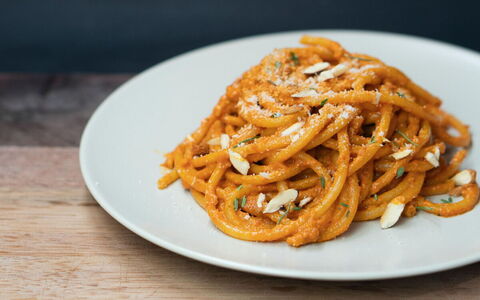
Some of the best meals in Chianti are not elaborate.
This is countryside cooking shaped by what grows and is raised nearby: handmade pasta, beans, bread, game, grilled meat, pecorino, olive oil and vegetables that change with the season.
A good week should include different registers rather than seven formal dinners.
Have bistecca in or around Panzano. Find a traditional trattoria for pappardelle with wild boar or another local ragù. Eat lunch at a wine estate. Book somewhere special for one evening, then spend another eating simply at the villa with tomatoes, pecorino, salumi and a bottle bought that afternoon.
Among the restaurants Salogi has recommended in the region are Ristoro di Lamole, with its position above the Chianti hills; Osteria di Fonterutoli, in the Mazzei family's historic wine estate; Antica Trattoria La Torre in Castellina; Badia a Coltibuono near Gaiole; and Osteria di Passignano farther north in the Chianti Classico area.
Restaurant openings, chefs and menus can change, so reservations should always be checked before travelling - particularly in high season.
For a larger selection, see our guide to The Best Restaurants in Chianti.
What a week in Chianti actually looks like
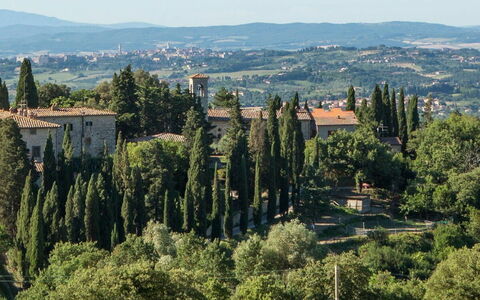
The temptation is to fill every day. We would resist it.
One of the reasons to rent a villa here rather than pass through on a Tuscany road trip is that your accommodation becomes part of the holiday. A pool, garden and long table overlooking the hills are not simply where you sleep between excursions.
Here is the rhythm we recommend for the first week.
Day 1: arrive and stay close to home
Do not schedule a wine tasting for two hours after landing.
Arrive at the villa, buy groceries, unpack and understand your immediate surroundings. If there is a village nearby, go there for an aperitivo or an uncomplicated dinner. The first evening in Chianti should be quiet.
Day 2: Greve, Montefioralle and Panzano
Start with Greve's Piazza Matteotti, then continue to Montefioralle.
Have lunch around Panzano and spend the afternoon at a winery nearby. If you still have energy, take the slower road home through the vineyards rather than racing back along the main route.
Day 3: a villa day
This is important. Have breakfast late. Swim. Read. Drive out only for lunch or provisions. Travellers often underestimate the amount of time absorbed by winding roads, lunches and tastings in Chianti. A deliberately empty day changes the rhythm of the whole week.
Day 4: Radda, Volpaia and the high Chianti hills
Go to Radda in the morning, stopping for coffee before continuing to Volpaia. Book lunch or a wine tasting in this part of the region. Spend the rest of the afternoon driving the smaller roads around Radda rather than adding another major town. Return to the villa for dinner.
Day 5: Siena
Chianti sits between two of Italy's great art cities, but Siena makes particular sense from the southern part of the region.
Go early, spend the morning and lunch (we particularly like Restaurant Le Logge) in the city and return before evening. It is enough time to experience a dramatic change of scale without turning the day into an endurance test.
Day 6: Castellina, a winery and dinner out
Spend the morning in Castellina and walk the Via delle Volte.
Book a winery for the afternoon, preferably somewhere between Castellina and your villa, then make this the evening for a restaurant reservation you have been looking forward to.
Day 7: Gaiole, Brolio and one last long lunch
Use the final full day for the eastern side of Chianti.
Visit Brolio or explore the countryside around Gaiole, then make lunch the central event. Leave the afternoon deliberately loose. Buy a final bottle or two to take home and return to the villa while there is still time to enjoy it.
That is more than enough.
When is the best time to visit Chianti?
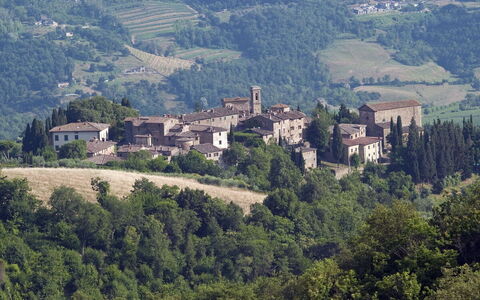
There is no single ideal month, but the region changes considerably through the year.
- May and June bring long days and intensely green countryside. It is an excellent period for walking, cycling and eating outside.
- July and August are warmer and busier. The great advantage is villa life: swimming, late dinners outdoors and excursions early in the morning or towards evening.
- September and early October are particularly atmospheric because they coincide with the grape harvest period, which in Chianti Classico generally runs from the first half of September into October depending on altitude and location. September also brings important local wine events, including the Chianti Classico Expo in Greve and Vino al Vino in Panzano.
- Late October and November are quieter. Vineyards change colour, restaurants feel more local again and new olive oil begins to appear.
Do you need a car in Chianti?
For the kind of Chianti holiday described in this guide, yes.
A car gives you access to the small villages, wine estates and rural restaurants that make the region interesting. Public transport exists between some larger centres, but it does not reproduce the freedom of stopping at a viewpoint, changing plans after lunch or taking an unmarked road because it looks beautiful.
Avoid choosing an unnecessarily large vehicle. Village streets, parking spaces and gravel drives can be considerably narrower than visitors expect.
And if you are visiting wineries, plan ahead: use a driver for serious tasting days or designate someone who is not drinking.
Florence or Siena from Chianti?
Both.
Which one is easier depends on exactly where your villa is.
Northern Chianti naturally leans towards Florence. From the southern and eastern parts of the region, Siena may be the more effortless excursion.
But we would not commute into either city every day. If your objective is primarily museums and monuments, stay in Florence or Siena. Choose Chianti because you want the countryside itself to be the destination.
The real luxury of Chianti is having nowhere else to be
A first-time visitor can easily construct a Chianti itinerary containing six towns, four wineries, three castles and two cities.
We would edit that list in half.
The region reveals itself in the time between appointments: stopping for coffee in Radda, taking the wrong turn outside Gaiole, talking to someone at a vineyard for longer than expected, buying pecorino for dinner, or watching the shadows move across the hills from the terrace of your villa.
That is why Chianti works particularly well as a week-long destination rather than a day trip from Florence.
Choose a good base. Book a handful of things that matter. Leave the rest of the week with room to change.
Explore our collection of Villas in Chianti, from restored country houses to estates surrounded by vineyards, or browse our Tuscany Vineyard Villas for a stay even closer to Tuscany's wine culture.
- The Ultimate Florence Travel Guide: Everything You Need To Know
- The Best Wine And Olive Oil Tours In Lucca Countryside
You May Also Like

Travel Guides
Our tips to discover Tuscany. Here you will find our recommendations from places to go and things to do, from restaurants to where to park your car, etc.

Activities, Day Trips & Attractions
There is an extensive list of things you can do in Tuscany, we have selected some we believe should not be missed when exploring the region

Chianti Guide
Discover the best of Chianti with our Chianti Guides. From vineyard tours and wine tastings to local food, events, and scenic villages, this collection of articles will help you explore the heart of Tuscany and make the most of your visit.

Florence Guide
Discover the best of Florence with our Florence Guides. From local food and drink spots to events, activities, and must-see attractions, these articles will help you explore the city’s charm and make the most of your time in Tuscany.

Lucca Guide
Discover the best of Lucca with our Lucca Guides. From food and drink recommendations to events, activities, and top things to do, this collection of articles will help you explore the city’s historic walls, lively piazzas, and timeless Tuscan charm.

Maremma Guide
Discover the best of Maremma with our Maremma Guides. From food and wine experiences to outdoor adventures, local events, and beautiful coastal towns, this collection of articles will help you explore one of Tuscany’s most unspoilt regions.

Search by Categories
Get inspired by our articles about activities, places and suggestion, to make your holiday in Tuscany and Italy a memorable experience.

Pisa Guide
Discover the best of Pisa with our Pisa Guides. From food and drink recommendations to events, activities, and top things to do, this collection of articles will help you explore the city’s famous landmarks and riverside charm.

Siena Guide
Discover the best of Siena with our Siena Guides. From food and drink recommendations to events, activities, and top things to do, this collection of articles will help you explore the city’s medieval streets and rich Tuscan traditions.

Food and Wine
The Tuscan cuisine and wine are well known around the world. There are countless wineries and restaurants in the region, in this section you will discover Salogi's selection.

History & Culture
Learn about Tuscan history and its people. Find out what's unique about the region's traditions and customs to best explore Tuscany during your holiday

Salogi News & Travel Information
This section of our magazine contains articles to support you in booking your perfect home. It can be useful when planning a holiday in Tuscany.